
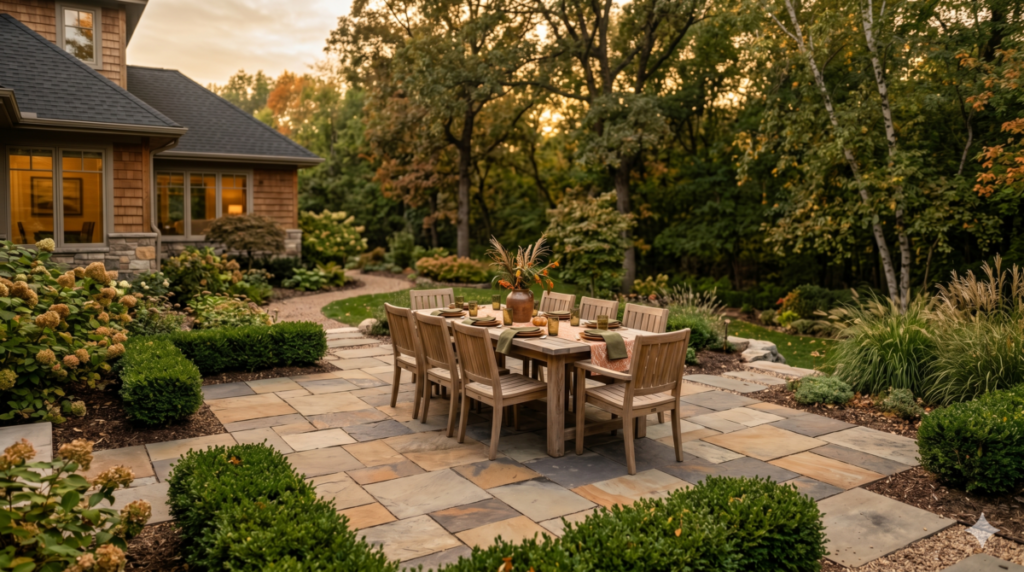
Victoria lots tend to run larger than neighboring cities, which opens up custom patio designs that would not fit in Chanhassen or Eden Prairie. When Victoria homeowners ask us what material to choose, the answer usually comes down to a straightforward comparison between concrete pavers and natural stone. Here is how that decision plays out.
Table of Contents
- Concrete Pavers: The Reliable Workhorse
- Natural Stone: The Premium Character Option
- Winter Performance in Carver County
- How to Choose for Your Victoria Yard
- FAQs
- Ready to Get Started?
Concrete Pavers: The Reliable Workhorse
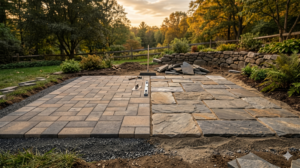
Modern concrete pavers are a different product than the gray 1990s hex paver your parents might have had. Today’s pavers come in hundreds of color blends, multiple surface textures, and sizes from 3 by 6 inches up to 12 by 24 inch large-format slabs.
Pros: predictable cost ($35 to $55 per square foot installed), consistent dimensions for clean patterns, excellent freeze and thaw performance when properly manufactured, easy to repair individual units.
Cons: color and texture never fully match natural stone, pigment can fade slightly over 15 to 20 years, can look more uniform than some homeowners want.
Natural Stone: The Premium Character Option
Natural stone is the upgrade path for Victoria homeowners who want their patio to feel permanent and one-of-a-kind. Bluestone, limestone, and granite are the three most common choices for Minnesota.
Pros: each piece is unique, no fading over time, reads as premium material from the street, patinas beautifully.
Cons: higher cost ($60 to $95 per square foot installed), thicker bedding required, harder to source replacement pieces if you need repairs later, color matching is more art than science.
Winter Performance in Carver County
Both materials can survive Minnesota winters when properly installed, but with different failure modes.
Pavers fail at the joints (polymeric sand washes out) or at the base (inadequate Class 5 depth lets frost heave lift units). Natural stone fails more often at the bedding (stone rocks in place because the bedding layer was too thin) or chips at edges under ice expansion.
Class 5 base depth of 8 to 12 inches and a full polymeric sand fill make the biggest difference in long-term performance for both materials.
How to Choose for Your Victoria Yard
A few decision rules that work:
- Budget is tight or you want symmetrical patterns: go with premium concrete pavers
- The home is high-end custom and you want character: go with natural stone
- You are building a pool surround: large-format concrete pavers usually win on slip resistance
- You want low fuss 20 years from now: pavers win on repair access
Frequently Asked Questions
How long do concrete pavers last in Minnesota?
A professionally installed concrete paver patio with proper base prep should last 30 years or more. Individual pavers may need replacement after 25 to 30 years due to surface wear.
Is natural stone slippery in Minnesota winters?
Some natural stones with smooth finishes can be slippery when icy. Bluestone with a thermaled finish and flamed granite are less slippery. Talk with your contractor about finish choice before ordering.
Can I mix pavers and natural stone in one patio?
Yes, and it can look great. A common approach is using pavers for the field and natural stone for borders, steps, or feature areas. Mixing materials requires careful planning on joint layout.
Ready to Get Started?
Three Timbers serves Chanhassen, Eden Prairie, Minnetonka, Chaska, Victoria, Excelsior, Waconia, and Mound with full-service landscape and hardscape work. Call (612) 214-1955 or request a free estimate from our Victoria landscaping team. You can also see our full Minnesota landscaping and hardscape services.
Related reading: