
Doing work at the water line on a Minnesota lake means working with the Minnesota DNR. The permit process is less intimidating than homeowners think, but it has real timelines and clear rules. Here is what to expect.
Table of Contents
- When a DNR Permit Is Required
- Soft-Armoring Often Does Not Need a DNR Permit
- The Permit Process Timeline
- Typical Permit Costs
- FAQs
- Ready to Get Started?
When a DNR Permit Is Required
Work that triggers a DNR Public Waters Work Permit:
- Placing fill, riprap, or structures below the Ordinary High Water Level
- Dredging or excavation in public waters
- Bridge or dock construction beyond statutory exemptions
- Shoreline armoring beyond the general permit allowances
Work above the OHW on upland portions of your shoreline typically does not require a DNR permit, but may still require local (city, watershed district) permits.
Soft-Armoring Often Does Not Need a DNR Permit
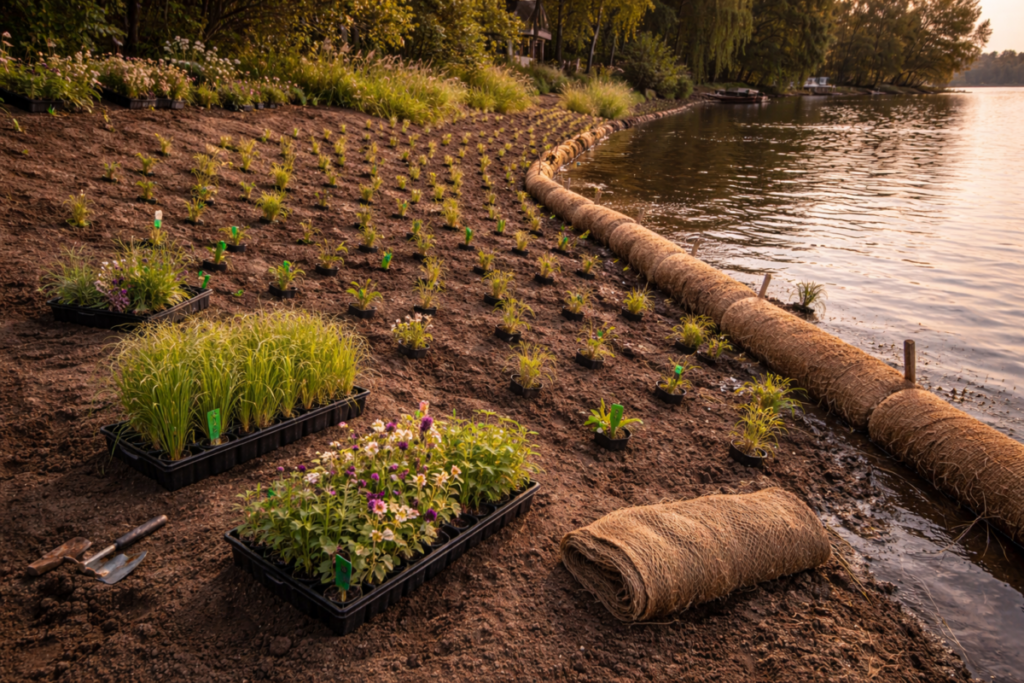
Per DNR rules, shoreline restoration using natural materials (willow wattles, brush mattressing, fiber rolls, native plants) does not require a DNR permit when:
- The project is designed or reviewed by the local SWCD or watershed district
- The design does not interfere with navigation
- Work is done outside fish spawning and bird nesting windows
- Native plantings are used
- Waterward encroachment is minimal
This general permit approach is how most soft shoreline restoration projects proceed in Minnesota.
The Permit Process Timeline
For projects that do require a DNR permit:
- Pre-application consultation with DNR area hydrologist (2 to 4 weeks)
- Permit application submission
- DNR review (8 to 12 weeks typical; longer for complex projects)
- Public notice period (may apply)
- Permit issuance with conditions
- Work must align with permit conditions (work windows, BMPs, monitoring)
Plan on 3 to 6 months from first call to permit in hand for most residential projects.
Typical Permit Costs
DNR permit application fees for residential shoreline work typically run $150 to $500 depending on scope. Some projects also require local city permits ($50 to $250) and watershed district permits (varies by district).
The bigger cost is usually the engineering or design work required to get a permittable project. Budget $1,500 to $5,000 for design review on complex restorations.
Frequently Asked Questions
Can I remove downed trees from my shoreline without a permit?
Typically yes, above the Ordinary High Water Level. Working below the OHW or removing root masses that stabilize the bank may require review. Check with your watershed district first.
What is the Ordinary High Water Level?
The OHW is a legal boundary defined by the DNR, typically marked by the line on the bank where vegetation changes. For most lakes it is clearly mapped; your surveyor or your watershed district can confirm for your shoreline.
How long does a complete shoreline restoration project take?
Soft-armor restoration without major permits: 4 to 12 weeks from design to install, plus 2 to 3 years of establishment. Projects requiring DNR permits: 6 to 18 months from start of permit to restoration completion.
Ready to Get Started?
Three Timbers serves Chanhassen, Eden Prairie, Minnetonka, Chaska, Victoria, Excelsior, Waconia, and Mound with full-service landscape and hardscape work. Call (612) 214-1955 or request a free estimate from our Chanhassen landscaping team. You can also see our full Minnesota landscaping and hardscape services.
Related reading: