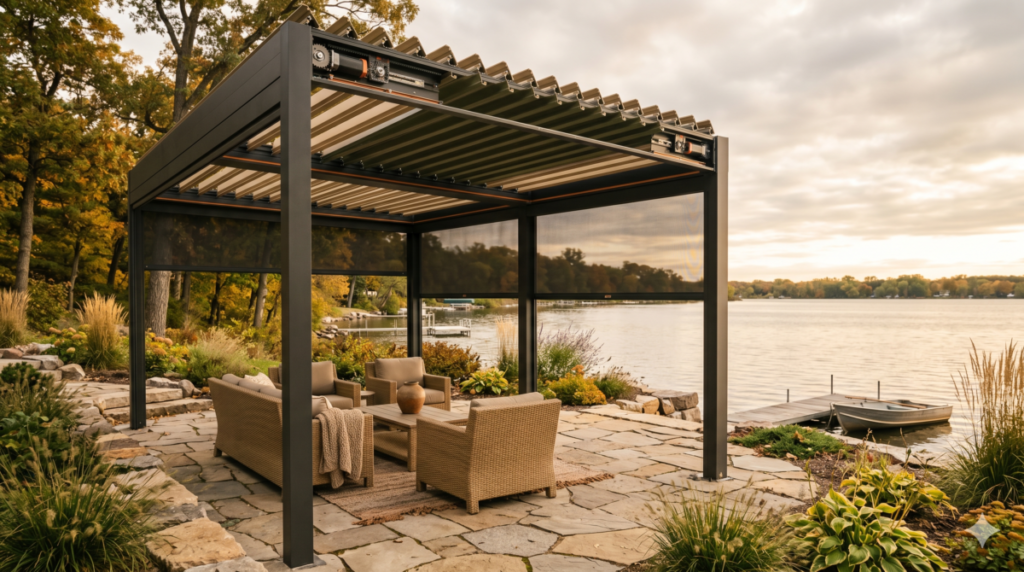
An outdoor living space on Lake Minnetonka has to earn its keep across a climate that swings 120 degrees between January and July. The features that get designed once and used for 20 years tend to share a few characteristics. Here is what holds up.
Table of Contents
- Season-Extension Features That Actually Work
- Materials That Survive Lake-Exposed Winters
- Zones That Make a Lake Patio Work All Year
- Features That Do Not Earn Their Keep
- FAQs
- Ready to Get Started?
Season-Extension Features That Actually Work
Three features consistently extend a Minnesota outdoor living season from the standard 5 months to a realistic 9 or 10:
- Louvered roof pergolas. Motorized louvers open for sun, close for rain or sun shade. Paired with retractable side screens, you have a three-season room at the push of a button.
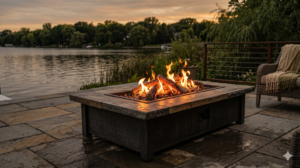
- Fire features with radiant heat. Gas fire pits, fire tables, and built-in fireplaces extend evening use into October and March. Wood-burning features push further but require more maintenance.
- Infrared heaters. Ceiling-mounted under pergola structures, they warm people without heating the air. Effective to about 30 degrees ambient.
Materials That Survive Lake-Exposed Winters
Lake Minnetonka lakeshore lots catch more wind, ice, and moisture than inland properties. Material choices that consistently hold up:
- Dense, low-absorption concrete pavers (avoid soft or porous units)
- Natural bluestone with thermaled (not honed) finishes for traction
- Cedar or composite wood for pergolas and privacy screens
- Powder-coated steel or aluminum for structural pergolas
- Stainless steel or marine-grade hardware at all connections
Zones That Make a Lake Patio Work All Year
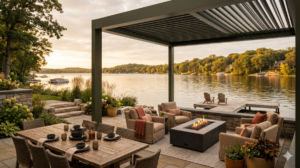
A Lake Minnetonka outdoor living space works best when broken into three or four distinct zones rather than one large open patio:
- Cooking and prep zone, close to the kitchen door
- Dining terrace under cover (pergola, awning, or three-season room)
- Fire feature lounge with deep seating
- Lake-view terrace for morning coffee and sunset drinks
Separation matters because it lets different family members use different zones at the same time without crowding.
Features That Do Not Earn Their Keep
A few popular features consistently underperform on Minnesota lake lots:
- Outdoor televisions in uncovered locations (rain and snow kill them in 3 to 5 years)
- Wood-fired pizza ovens used fewer than 6 times a year (expensive per use)
- Misting systems (short season, winterization complex)
- Thin-gauge aluminum pergolas without snow load engineering
Frequently Asked Questions
Can I use my Lake Minnetonka patio in winter?
Yes, with the right features. A covered three-season space with a fire feature and infrared heat is usable into late November and again from March. Full year-round use requires an enclosed four-season room.
Do I need a permit for a pergola on my Lake Minnetonka lot?
Most cities require a permit for pergolas over a certain size or attached to the house. Lakeshore lots add shoreland setback and impervious surface caps on top. Check with your city before finalizing the design.
How much does a high-end outdoor living space cost on Lake Minnetonka?
Full-scope outdoor living on a Lake Minnetonka lot (patio, pergola, fire feature, outdoor kitchen, lighting) runs $75,000 to $300,000 depending on size and finish. Phased approaches over multiple seasons are common.
Ready to Get Started?
Three Timbers serves Chanhassen, Eden Prairie, Minnetonka, Chaska, Victoria, Excelsior, Waconia, and Mound with full-service landscape and hardscape work. Call (612) 214-1955 or request a free estimate from our Minnetonka landscaping team. You can also see our full Minnesota landscaping and hardscape services.
Related reading: