
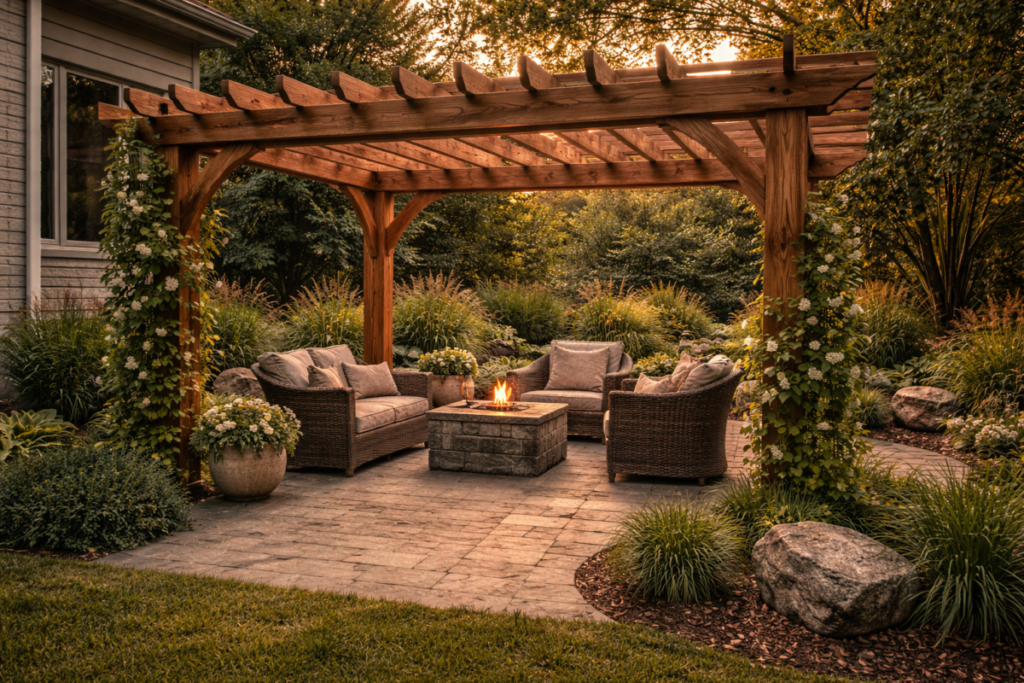
A pergola on a Minnesota lot has to survive 50 PSF snow loads, wild temperature swings, and pressure from wind off open fields or lakes. Material choice matters more here than in milder climates. Here is how cedar, composite, and steel actually compare in the Twin Cities market.
Table of Contents
- Cedar: The Traditional Choice
- Composite: Low-Maintenance Modern
- Steel and Aluminum: Long Spans and Louvered Roofs
- Pergola Foundations in Minnesota
- FAQs
- Ready to Get Started?
Cedar: The Traditional Choice
Western red cedar or white cedar is the default pergola material in the Twin Cities. Pros: natural look, good insect and rot resistance, accepts stain and paint.
Cost: $3,000 to $8,000 for a basic 10×10 installed. Premium custom cedar with detailed joinery runs $8,000 to $18,000.
Lifespan in Minnesota: 15 to 25 years with regular staining every 3 to 5 years. Lifespan drops fast without maintenance.
Composite: Low-Maintenance Modern
Composite pergolas use aluminum or fiberglass structural members wrapped in composite cladding. No staining, no rot, clean modern look.
Cost: $25 to $40 per square foot installed, which translates to $7,000 to $12,000 for a 10×10 unit, or $15,000 to $30,000 for larger custom builds.
Lifespan: 25 to 40 years with minimal maintenance. Cladding holds color much longer than stained cedar.
Steel and Aluminum: Long Spans and Louvered Roofs
Powder-coated steel and aluminum are the go-to for pergolas with long clear spans, attached to the house, or with motorized louvered roofs.
Cost: $30 to $70 per square foot installed. Louvered roof systems run $15,000 to $35,000+ in the Lake Minnetonka market.
Snow load: Steel and aluminum easily handle Minnesota’s 50 PSF minimum snow load requirement, including drift loads against the house.
Pergola Foundations in Minnesota
Minnesota’s 42 inch frost depth applies to pergola footings just as it does to decks. Proper foundations:
- Concrete footings to 42 inches (Zone II, Twin Cities metro)
- Sonotube pours with steel post brackets above grade
- For attached pergolas, structural connection to house with flashing
Surface-mount pergolas without frost footings will heave and eventually fail.
Frequently Asked Questions
Do I need a permit for a pergola in Minnesota?
Most cities require a permit for pergolas over a certain size (typically 120 square feet) or when attached to the house. Unattached garden pergolas under the size threshold often do not. Confirm with your city.
What’s the Minnesota snow load requirement for a pergola?
The state building code requires structures to handle at least 50 PSF ground snow load. Contractors should verify the specific snow load for your county; some counties require higher numbers.
Can I add a louvered roof to an existing cedar pergola?
Sometimes, if the cedar structure is sized to carry the added roof weight (louvered roofs add 3 to 5 PSF plus snow load). Most retrofits require structural upgrades. Often cheaper to replace with a purpose-built aluminum system.
Ready to Get Started?
Three Timbers serves Chanhassen, Eden Prairie, Minnetonka, Chaska, Victoria, Excelsior, Waconia, and Mound with full-service landscape and hardscape work. Call (612) 214-1955 or request a free estimate from our Chanhassen landscaping team. You can also see our full Minnesota landscaping and hardscape services.
Related reading: