
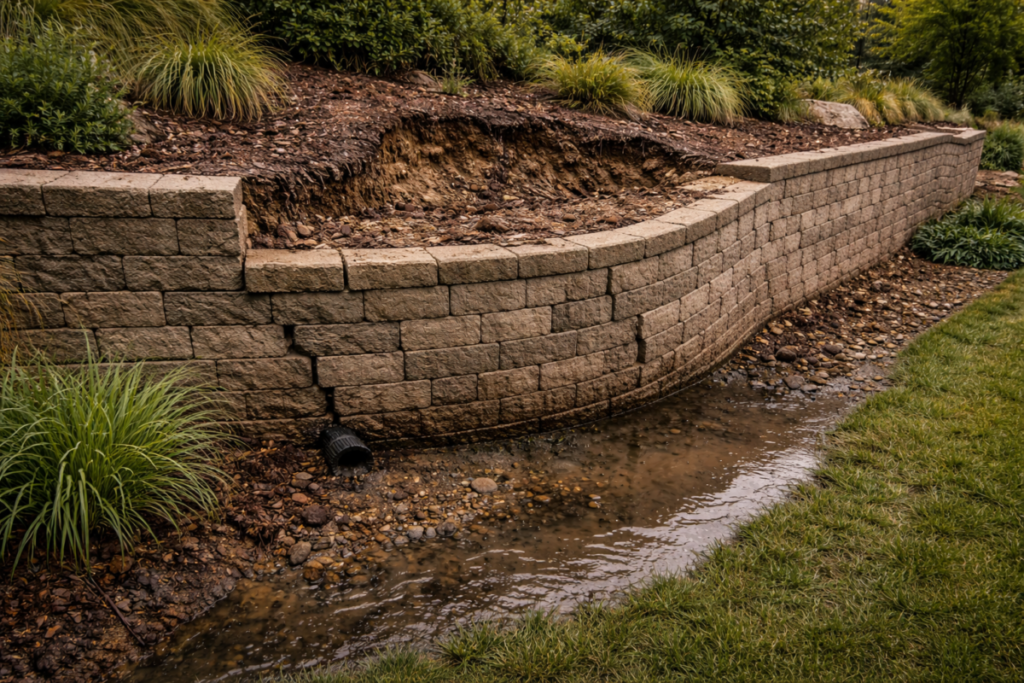
Minnesota retaining walls fail for predictable reasons. The failures are not random, they are not acts of God, and they are not just the passage of time. They trace to specific shortcuts made during install, almost always on the things buried out of sight. Here are the five reasons Minnesota walls fail and how to prevent each one.
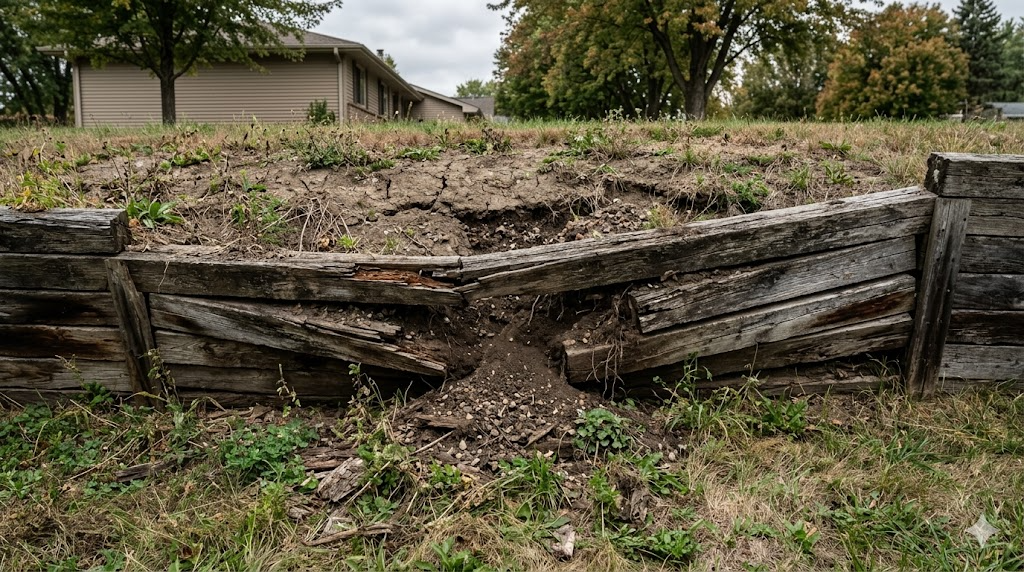
Table of Contents
- Reason 1: Missing or Failed Drainage
- Reason 2: No Geogrid Reinforcement
- Reason 3: Inadequate Base Prep
- Reason 4: No Engineering on Tall Walls
- Reason 5: Bad Grade Above the Wall
- FAQs
- Ready to Get Started?
Reason 1: Missing or Failed Drainage
The most common cause by a wide margin. A retaining wall without drain tile behind it builds up hydrostatic pressure every spring and fall. After a few freeze cycles, the wall is leaning.
Prevention: perforated drain tile at the footing, geotextile-wrapped gravel backfill for the full height of the wall, and a positive outlet to daylight or a dry well. If your bid does not line-item drain tile, ask why.
Reason 2: No Geogrid Reinforcement
Walls over about 3 feet tall need geogrid, a plastic mesh that extends into the backfill and ties the wall to the soil mass behind it. Without geogrid, tall walls rely only on the weight of the blocks to resist pressure. Minnesota clay behind the wall eventually wins.
Prevention: geogrid every 2 to 3 courses for walls over 3 feet, extending 4 to 6 feet into the backfill. Engineered designs specify the exact pattern.
Reason 3: Inadequate Base Prep
Walls settle from the bottom. A 6 inch compacted Class 5 footing for a tall wall is inadequate. Proper base prep includes:
- Excavation below the frost line where walls are rigid structures
- 12 to 18 inches of compacted aggregate base
- Level, screeded first course
Walls built on native topsoil without proper base fail quickly once clay saturation starts.
Reason 4: No Engineering on Tall Walls
Walls over 4 feet tall (including buried footing) legally require engineered design in Minnesota. Contractors who skip engineering are cutting a corner that can turn into a safety liability.
Prevention: engineered stamped drawings for any wall approaching 4 feet. Cost of engineering ($800 to $2,500) is small compared to wall replacement.
Reason 5: Bad Grade Above the Wall
Even a perfectly built wall fails if rainwater sheets toward it from upslope. Water accumulates behind the wall, freezes, expands, and pushes the wall forward.
Prevention: finished grade above the wall slopes AWAY from the wall, not toward it. A swale diverting runoff around the wall often costs a few hundred dollars and adds decades of life.
Frequently Asked Questions
My retaining wall is leaning. Can it be fixed without replacing?
Sometimes. Minor lean (under 2 degrees) with otherwise good base can sometimes be pinned or reinforced. Significant lean usually means base or drainage failure, and rebuilding is more durable and cost-effective than repair.
How do I know if a wall has drainage behind it?
Dig down behind the wall at the footing level. You should find gravel wrapped in filter fabric and a perforated drain pipe. If you find only native soil, the wall is at risk.
Can I build a retaining wall myself and have it pass inspection?
DIY retaining walls under 4 feet typically do not require permits or inspection in Minnesota. Walls over 4 feet require engineering and a permit regardless of who builds them. Most cities allow homeowners to pull permits and build, with proper engineering and inspection.
Ready to Get Started?
Three Timbers serves Chanhassen, Eden Prairie, Minnetonka, Chaska, Victoria, Excelsior, Waconia, and Mound with full-service landscape and hardscape work. Call (612) 214-1955 or request a free estimate from our Chanhassen landscaping team. You can also see our full Minnesota landscaping and hardscape services.
Related reading: