
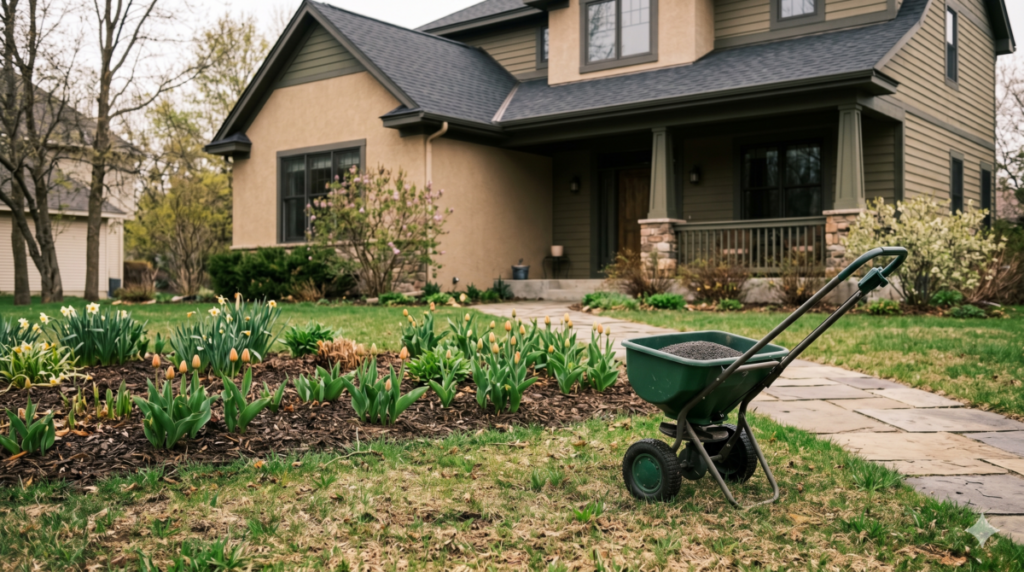
Minnesota spring lawn care is mostly about timing. Do the right things in the right order from March to May and your lawn coasts through summer. Skip a step or run it too early and you fight problems the rest of the year. Here is the realistic month-by-month checklist.
Table of Contents
- Late March: Assessment Only
- Mid-April: First Work Begins
- Crabgrass Preemergent Window: Mid-April to Early May
- May: Establishment and Fertilizer
- FAQs
- Ready to Get Started?
Late March: Assessment Only
While the ground is still firm but not frozen, walk the lawn and identify: snow mold patches (gray or pink circles), vole runs, winter desiccation on exposed slopes, and any bare soil from shoveled areas. Do not rake or dethatch yet. Wet soil compacts badly and cool soil is not ready for anything else.
Mid-April: First Work Begins
Once soil has dried out and temperatures are consistently above 40 degrees at night:
- Light power rake or leaf-rake any remaining snow mold patches
- Pick up winter debris
- First mow at 3 inches, cleaning up any long patches
- Start watching for the crabgrass preemergent window (see next section)
Crabgrass Preemergent Window: Mid-April to Early May
The University of Minnesota’s Turfgrass Science team sets the window this way: apply crabgrass preemergent before soil temperatures hit 55 degrees for several consecutive days in the upper 1 to 2 inches of soil. A reliable visual cue: when forsythia finishes blooming and lilacs are about to bloom, you are in the window.
Critical: do not dethatch or aerate after applying preemergent. Both disrupt the chemical barrier in the soil and let crabgrass through.
The UMN Turfgrass Science page publishes real-time soil temperature readings each spring.

May: Establishment and Fertilizer
Mid to late May is when the lawn is actively growing and responds to fertilizer. Apply a balanced starter or maintenance fertilizer. Mow at 3 to 3.5 inches, never cutting more than one-third of the blade length at a time. Begin deep, infrequent watering if rainfall is below an inch per week.
This is also the window for overseeding thin areas, assuming you did not apply a preemergent.
Frequently Asked Questions
When should I dethatch my Minnesota lawn?
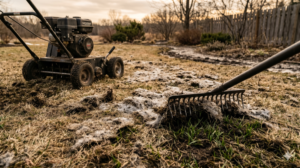
Late summer (mid-August to September) is actually the best window in Minnesota, not spring. Spring dethatching disrupts crabgrass preemergent barriers and stresses grass that is just coming out of dormancy.
Can I apply fertilizer in March?
Usually too early. Fertilizer applied before the grass is actively growing runs off or burns. Wait until mid-to-late April at earliest, once the lawn is greening up consistently.
What height should I mow at in spring?
Start at 3 inches on the first mow to clean up long areas, then shift to 3 to 3.5 inches for the rest of the season. Higher cut heights shade soil, reduce weed germination, and reduce water use.
Ready to Get Started?
Three Timbers serves Chanhassen, Eden Prairie, Minnetonka, Chaska, Victoria, Excelsior, Waconia, and Mound with full-service landscape and hardscape work. Call (612) 214-1955 or request a free estimate from our Chanhassen landscaping team. You can also see our full Minnesota landscaping and hardscape services.
Related reading: