
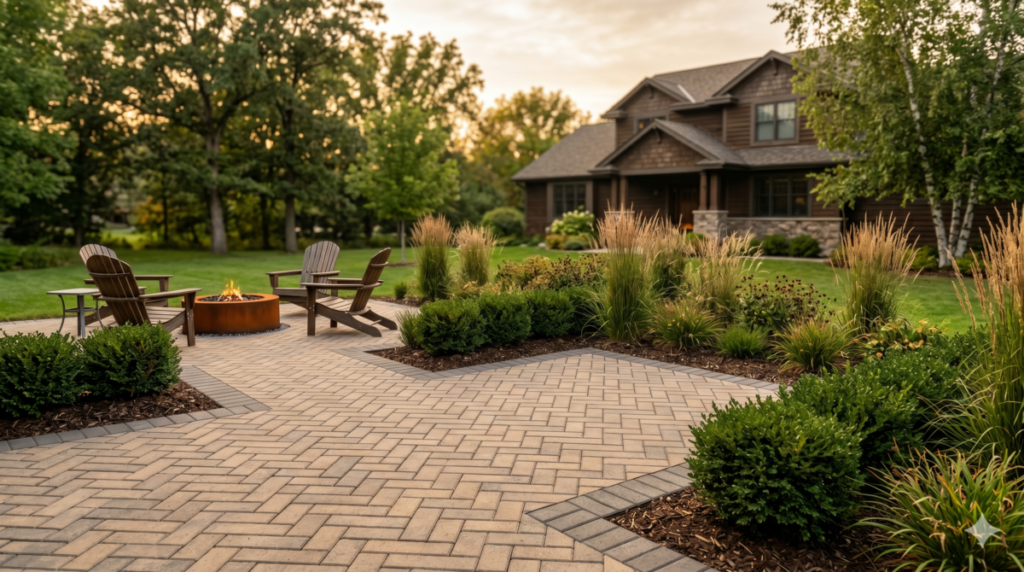
If you have seen a paver patio tilt, crack, or grow a mysterious hump in the middle, you have seen frost heave in action. In Chanhassen, with heavy clay soil and ground that freezes 42 inches deep, the wrong base prep can turn a beautiful patio into a costly do-over in three winters flat. Here is what local homeowners need to know before breaking ground on a new patio.
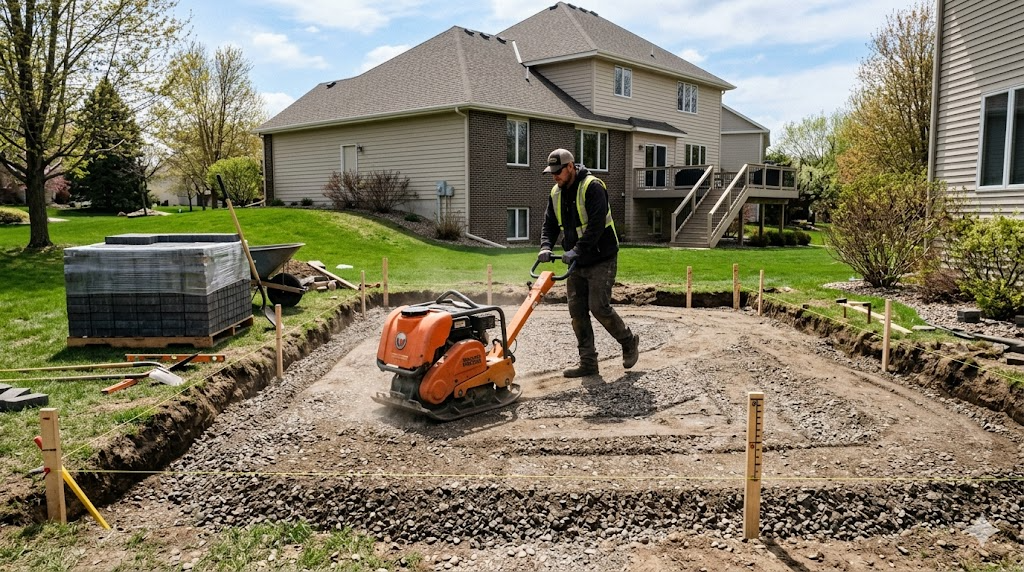
Table of Contents
- Why Frost Heave Is a Chanhassen Problem
- How Minnesota Frost Depth Affects Patio Design
- The Base Prep That Actually Holds Up
- Permits, Setbacks, and Zoning Rules in Chanhassen
- Picking the Right Paver Material
- Cost Expectations for Chanhassen Patios
- When to Install (and When Not To)
- FAQs
- Ready to Build It Right?
Why Frost Heave Is a Chanhassen Problem
Water expands roughly 9 percent when it freezes. That sounds small, but when it happens across hundreds of gallons of soil moisture under your patio, the upward force is enough to lift slabs, push pavers out of plane, and split concrete down the middle.
Chanhassen sits on heavy clay with pockets of loam near the lake areas. Clay holds water. Water sitting still while the ground freezes is exactly the recipe for frost heave. Eden Prairie, Chaska, Victoria, and the rest of the southwest Twin Cities metro share this soil profile, which is why patios installed without proper drainage fail at nearly identical rates across the region.
The damage shows up in predictable ways: pavers at the edges settle while the center lifts, joints open wide enough to lose polymeric sand, steps separate from landings, and patios start to pull away from the house foundation. None of this is cosmetic. Once pavers shift, water infiltrates the base, which speeds up the next round of damage.
How Minnesota Frost Depth Affects Patio Design
Minnesota’s residential building code divides the state into two frost zones. Zone I, north of St. Cloud, uses a 60-inch minimum footing depth. Zone II, which includes the entire Twin Cities metro and all of Carver County, uses 42 inches. That number is your north star when planning a hardscape project in Chanhassen.
For patios, the frost depth does not mean you excavate 42 inches of soil for a flat hardscape surface. It means your base system has to be engineered so water drains away from that depth before it has time to freeze in place. Done right, your patio is essentially floating on a compacted, free-draining aggregate cushion that neutralizes frost movement.
Skip that engineering step and even the best-looking pavers will tell on their base within a few Minnesota winters.
The Base Prep That Actually Holds Up
A Chanhassen paver patio built to survive decades of freeze and thaw cycles needs the following:
- Excavation to the right depth. Plan on 10 to 14 inches of total dig below finished grade for most residential patios. Driveways and heavy-use patios need more.
- Geotextile fabric. Commercial-grade woven fabric sits between native clay and your aggregate base. It prevents the clay from migrating upward and contaminating the drainage layer.
- Class 5 aggregate base. Eight to twelve inches of Class 5 (a graded aggregate blend of crushed limestone fines and larger chunks), compacted in six-inch lifts with a plate compactor. Not pea gravel. Pea gravel is round, it rolls, and it will not compact.
- Bedding sand. One inch of clean, coarse concrete sand, screeded flat. This is the setting bed, not a structural layer.
- Pavers and edge restraint. Pavers laid to pattern, then locked in with a continuous aluminum or steel edge restraint spiked into the base.
- Polymeric joint sand. Swept into the joints and activated with water so it hardens. This is what keeps water from running between pavers and destabilizing the base.
The shortcut most homeowners regret is skipping the Class 5 depth. Four inches of base under a Minnesota patio is a countdown to failure.
Permits, Setbacks, and Zoning Rules in Chanhassen
Patios fall under Chanhassen’s zoning permit category. The current zoning permit fee is $50. A few rules to know before you design:
- Setbacks. Your patio has to respect property line, lake, and wetland setbacks. If your lot backs to Lake Minnewashta, Lake Ann, or a protected wetland, the setback can be larger than you expect.
- Rear yard projection. Unenclosed decks and patios may project up to five feet into the rear yard, but they cannot cross drainage or utility easements.
- Lot coverage. The patio has to fit within your allowable impervious surface coverage. For many lakeshore lots this is the binding constraint.
- Code basis. Chanhassen uses the 2020 Minnesota State Building Code with local amendments.
If you are unsure whether your project needs a permit, the City of Chanhassen zoning permit page spells out current requirements. Community Development can be reached at (952) 227-1160. Most of the time, our team handles permit submission as part of the build so homeowners do not have to chase paperwork.
Picking the Right Paver Material
In a climate that sees 50-degree temperature swings in 24 hours, paver material matters more than it does in milder regions. Three options hold up well in Chanhassen:
- Concrete segmental pavers. The go-to for cost, color range, and consistency. Look for a dense, low-absorption unit rated for freeze and thaw cycles.
- Clay brick pavers. Beautiful, premium-priced, and extremely durable. They cost more but fade less over time.
- Natural stone. Bluestone, limestone, and granite all perform when properly bedded. Flagstone needs thicker bedding to prevent rocking.
Avoid anything marketed as an “overlay” that skips the base rebuild. You are solving for frost heave, not aesthetics alone, and a pretty surface on a failing base is still a failing patio.
Cost Expectations for Chanhassen Patios
Paver patios in the Chanhassen and Eden Prairie market typically run $35 to $55 per square foot installed, depending on paver choice, pattern complexity, grade, and site access. A 400-square-foot patio lands in the $14,000 to $22,000 range for a standard install. Add steps, seat walls, fire features, or complex curves and the number climbs from there.
A few things that tend to drive cost up in the southwest Twin Cities metro:
- Heavy clay excavation (slower, more haul-off)
- Tight side yards that require wheelbarrow-only access
- Slope correction and grading
- Lakeshore projects with DNR setback work
- Integrated lighting or drainage systems
For a more detailed pricing breakdown by square foot and material, our 2026 guide to paver patio cost in Minnesota walks through the line items.
When to Install (and When Not To)
Chanhassen’s install season for paver patios runs roughly mid-April through early November. Some of the best installs happen in late fall, once leaves drop and ground conditions are firm but not frozen. Spring jobs can get delayed by wet clay that refuses to compact.
Here is the realistic cadence:
- April to May. Design finalization, permit pulls, material orders.
- June to August. Peak install season.
- September to October. Prime install window, cooler temps, best curing.
- November. Last chance before the ground locks up.
Booking a Chanhassen patio installer in January for a summer install is not overkill. It is how the best crews get scheduled.
FAQs
How deep does a paver patio base need to be in Chanhassen?
Eight to twelve inches of compacted Class 5 aggregate over geotextile fabric, excavated to 10 to 14 inches below finished grade. Heavy clay soils on the east side of Chanhassen usually need the upper end of that range.
Do I need a permit for a patio in Chanhassen?
Most patios require a $50 zoning permit from the City of Chanhassen. Call Community Development at (952) 227-1160 to confirm setbacks, lot coverage, and easement rules for your specific address.
Can I install a paver patio over an old concrete slab?
Only if the slab is in perfect condition and at the right elevation, which is rare in Minnesota. Nine times out of ten, the old slab has to come out and the base needs a full rebuild.
How long does a Chanhassen patio installation take?
Most residential installs run five to ten working days from excavation through polymeric sand. Larger patios with seat walls, steps, or integrated lighting can run two to three weeks.
What happens if I ignore early frost heave damage?
Small high spots become trip hazards, joints open up, polymeric sand washes out, and the base layer loses integrity. At that point, a full rebuild is almost always cheaper than repeated spot repairs.
Ready to Build It Right?
Three Timbers installs paver patios across Chanhassen, Eden Prairie, Minnetonka, Chaska, Victoria, Excelsior, Waconia, and Mound. Every install starts with a site assessment, soil check, and a base plan built for Minnesota frost. Call (612) 214-1955 or request a free estimate from our Chanhassen landscaping team, and see the full range of Minnesota hardscape and landscaping services we offer.
Related reading: